






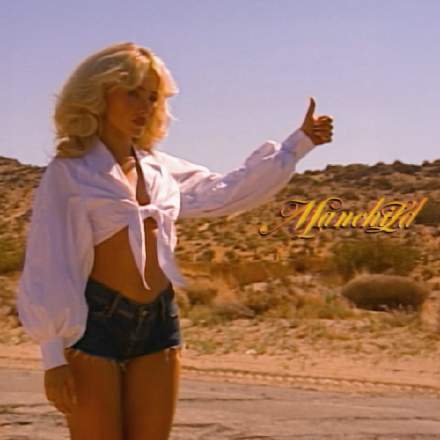
The mix sonics here have clearly been optimised for the most mass of mass-markets, in that the priority is clearly maximum audience reach rather than necessarily the most pleasant listening experience. So not much mix real estate is going to headroom-stealing low end, for example. There’s no EDM weight to the kick-drum here, despite abundant disco influences elsewhere in the production, with its main low-end energy being centred around 50-60Hz and pretty restrained in the balance to boot. Similarly, the chorus-section’s bass seems to have been fairly aggressively high-pass filtered below 60Hz, given that there’s precious little fundamental frequency to any of the notes except the highest (the C that underpins the final bar of the repeating harmonic progression) – something that results in a rather musically uneven line as that note suddenly booms out every four bars!
The extreme high-frequency density of the mix tonality is another clear indicator of the production’s commercial targeting, ensuring the clearest transmission of the hooks despite environmental interference (think car noise, hoovering, workplace/mall ambience, that kind of thing) and off-axis or acoustically shadowed listening positions. That does, however, make it a pretty abrasive listen on wider-range loudspeaker systems, and also pretty fatiguing for some headphone users too, which means it’s the kind of track where it’s hard to turn up the volume very far without wincing.
The stereo image fits the chart-pop mould too, with masses of width in the chorus’s textural guitar/synth layers and effects to impress earbud listeners, while all the core music content (ie. kick, snare, bass, vocals) remains fundamentally central to avoid any significant transmission loss under mono listening conditions. In particular, it’s worth noting how narrow the layered vocal texture’s image is here. This is quite unusual in pop productions, which often use wide-panned vocal double-tracks as image-widening fairy-dust – as in another of this year’s big hits, Huntrix’s 'Golden', for instance. Single-sided listening is also well catered for, with stereo elements generally being fairly evenly spread across the panorama and most panned mono sources being balanced using opposition panning (such as the double-tracked guitar riff at 1:13-1:20) – a notable exception being a few incidental backing-vocal responses (eg. “hey men!” at 2:21 and “always come running” at 2:45).
However, what really caught my ear in this mix was the beautifully paced long-term mix dynamics, and in particularly the way the production makes each chorus section a big deal in its own right, but also manages to build up the intensity of that section as it recurs throughout the song. For comparison, here’s the start of each chorus: Chorus 1: play_arrow | get_app Chorus 2: play_arrow | get_app Chorus 3: play_arrow | get_app On the most surface level, the fact that the second and third choruses begin with a big cymbal hit differentiates them, but you can also easily hear that the first chorus lacks some of the vocal layers too. However, it’s easier to appreciate the other textural changes if you compare midway through each chorus, away from those distracting cymbal hits: Chorus 1: play_arrow | get_app Chorus 2: play_arrow | get_app Chorus 3: play_arrow | get_app This reveals how much the chordal ‘filling’ of the sound is being inflated with each successive chorus, most audibly with the introduction of background distorted guitars in chorus two and sparkling sitar layers in chorus three. One of the most common shortcomings of project-studio mixes is the lack of this kind of long-term mix development, so I’d encourage anyone serious about commercial music production to start using locator points in their own mixes to do the same kind of listening comparison between different choruses that I’ve just shown you here, because it really helps focus your ear on exactly how your long-term mix dynamics are working. It’s such a powerful listening trick, and I personally use it on at least 90 percent of the mixes I do.
One final little tidbit: I can’t help feeling that the vocal line at 0:15-0:26 sounds a bit weird, on account of there being no breaths at all. That’s a long time for anyone to sing without breathing, and while it’s definitely within the bounds of possibility that Carpenter could sing it that way, she certainly didn’t do so in her live performances at the Grammies or on SNL (punctuated by three and two breaths respectively, and all in different places in the lyric too), so I’m dubious about any serious artistic intent there. Fundamentally, hearing this kind of thing on record always feels subliminally a little claustrophobic and disturbing, and I’d personally avoid it if I were you – unless that’s the effect you’re actually after!