






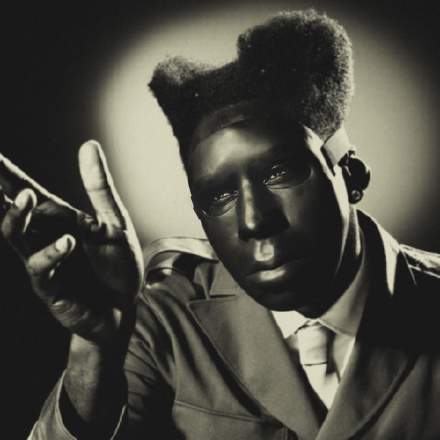
This production demonstrates one of the things I think hip-hop does best: taking a bunch of disparate sonic elements that many traditional music makers would disregard completely, or would never dream of using in combination, and fearlessly juxtaposing them into a unique tapestry that convinces almost by sheer force of character. Just the wayward tuning of the opening whistle, for instance, would have spurred many producers to retake the performance or fire up Melodyne, but not here, where the phrase’s unflinching repetition instead pulls the ear magnetically into the breathy texture of the whistle itself, and immediately adds a sense of authenticity to the production.
But what really caught my ear in this particular case was unapologetic dissonance of much of the bass part. This first becomes apparent at 1:12, where the line not only contains a prominent internal F-B tritone leap, but the main E and F pitches clash strongly against the sustained F# of the “it’s getting sticky” vocal hook and a clear F# pitch in the upper percussion loop. Then at 2:23, that same bass part is joined by brass layers which introduce a D#-E pitch contour that doubles the bass in parallel major sevenths. Although the bass seems to fall back into a more traditional consonant role following the arrival of the main brass riff (sampled from Young Buck’s ‘Get Buck’) at 2:36, the jazzy chord extensions that appear at 3:13 once more clash repeatedly, pitting Emaj7 and Bbb5 chords against its F# note and Dmaj7 against its E note.
What this approach does is undermine any expectation of traditional harmonic function (ie. that dissonances create a tension that requires a consonant resolution), allowing the coloristic and textural qualities of dissonance to be celebrated in their own right. The Second Viennese School made a stab at this in the classical world back in the 1920s, but unfortunately managed to exclude the bulk of the listening public in the process, something I’ve always felt was a enormous setback. What I love about the kind of hip-hop production Tyler The Creator has given us here is that it feels like it’s essentially pursuing the same underlying goal, but in a much more constructive and inclusive way, straining against the confines of functional harmony, but still maintaining broad appeal amongst musicians and non-musicians alike. With Viennese Schools, as with many things, perhaps three is the magic number…