






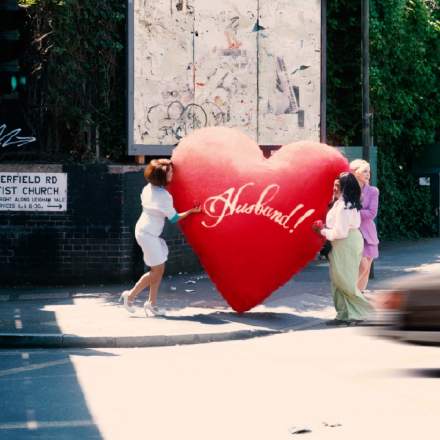
There’s so much about this genuinely funny production that I absolutely love! The melodic contrast between ferociously virtuosic patter (in the verses, middle section and outro), soulful diva melismas (in the prechoruses) and pure heads-down catchiness (in the chorus). The smoking-hot arrangement, assembling an army of horns over spectacular funk-bass riffage, and then bejewelling it with so many great vocal fills, such as “need you to tell me” at 1:45, “want it, want it, want it, want it, want it” at 2:17, “your husband is coming” at 2:53, and (my personal favourites) the unexpected mid-flow “doubt it” and “ooh!” at 2:17 and 3:02 respectively. The truly dazzling vocal arrangement, which not only showcases Raye’s effortlessly prodigious range of vocal techniques and timbres, but also maintains a textural restlessness that magnetically draws the ear – we’re constantly switching between solo, double-tracked, and harmonised lines from moment to moment, as well as layering numerous lines against each other and bouncing them back and forth in various call-and-response configurations. It’s enough to make your head spin!
But what elevates this song even beyond the heights already scaled by such lyrical, performance, and arrangement heroics (and that iconic Glastonbury set-opening) is a harmonic structure which underpins the song with that rarest of things in pop music: a solid foundation of musical momentum. And the MVP in this respect has got to be the fabulous prechorus progression first heard at 0:38, leading all the way from the tonic chord at the start of the section to the tonic chord at the beginning of the chorus, via an irresistably propulsive octave-spanning upwards line in the bass.
There are a couple of things that I think are particularly clever about the way this is done. Firstly, as we all know, there are seven notes in a basic scale. So if you want to fill an eight-bar section with a constantly rising chord-per-bar bass line stretching from tonic to tonic, then you’re either going to have to repeat a bass note, or you’re going to have to introduce some kind of chromatic addition along the way. Raye chooses the former path, and it’s interesting to see how she avoids her bass-note repetition stalling the sense of harmonic motion, which is always a risk. For the first four bars, the bass rises every bar, via a Bm-Adim/Cb-Db-Eb progression. Crucially, however, that fourth chord starts off as an Ebsus, only resolving its suspended fourth ( Ab) to the third ( G) halfway through the bar, and this sets up a chromatically falling line in the harmonic voicing that continues onwards to Gb as the bass repeats its note in bar five, resulting in the chord mode-switching to Ebm. It’s this mode-switch that really helps maintain a sense of musical momentum across the mid-section boundary, in my view, and after that it’s plain sailing, because the bass is then free to continue rising stepwise right up to the tonic at the start of the chorus.
That’s not the end of the fun, though, because there’s still a lovely surprise in store: for the final bar of the prechorus, the bass note doesn’t land on the Ab you’d have every right to expect, but instead chooses an A, giving us not only a more exotic augmented-second melodic leap, but also a spicy clash with the lead vocal line’s Ab, as well as the powerful harmonic impetus of a traditional dominant-tonic cadence. What’s more, when we get to the second half of the mid-section at 2:19, there’s a lovely falling bass line too, proceeding chromatically from Bb to G before dovetailing neatly with the second half of the prechorus pattern at 2:27.
It’s a production for the ages, and I’m delighted to see that it’s also given Raye her best US chart position so far. If you ask me, there’s such incandescent star quality on display here that it wouldn’t surprise me at all if the next song of hers I critique has nailed down the Billboard top spot. Watch this space…